Dar
Darma.
3 critic reviews
filed.
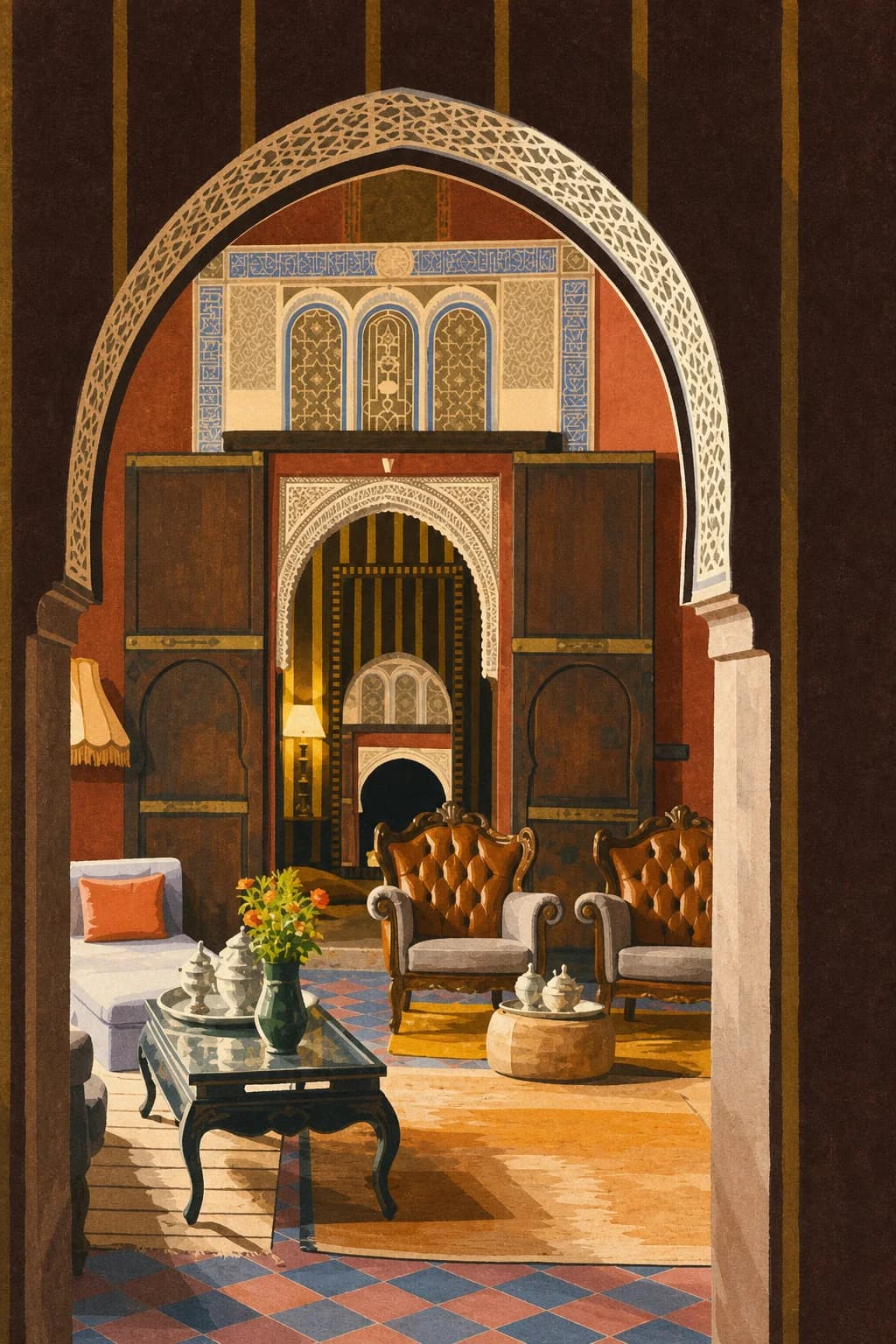
Dar Darma is six rooms in Mouassine with Italian ownership and interiors that lean Milan-meets-Marrakech, which is a specific aesthetic the city does not see often. The location puts you in the best walking zone of the medina. The hype softens that the Italian-Moroccan blend is the whole concept, so purists who wanted a traditional riad will find something deliberately hybrid.
The owners keep a small selection of their personal Italian pantry stocked in the kitchen and will put together a simple Italian lunch on request, served in the courtyard. For travellers who hit a wall on tagines by day four, it is the escape valve no other medina riad offers.
angles.
Locatelli's Maximalism
Italian designer Dario Locatelli designed each of the six suites as a separate world. The Red Suite is fire and gold. The Suite of Mirrors turns a bedroom into a hall of reflections. The Blue, Orange, Brown Patio, and Black Patio Suites each have their own palette and personality. Carved doors, lush velvet, hand-painted ceilings, Moroccan chequerboard floors. Every surface is finished. Nothing is left plain. In a design era dominated by restraint, Dar Darma chose abundance.
La Table and Maria's Classes
La Table Dar Darma serves traditional Moroccan food: harira, pastilla, lemon chicken, tagines. Ingredients come from Marrakech's souks, selected that morning. Meals are served in the courtyard, on the rooftop with moonlit Atlas views, in the lounges, or privately in your suite. Maîtresse Maria leads cooking classes on weekday mornings for a modest per-person fee. The food is home-style Moroccan, not restaurant-polished, and better for it.
El Moukef, Off the Map
El Moukef is the Medina district most visitors never reach. It's a cobbled side street away from the tourist flow, fifteen minutes on foot from Jemaa el-Fna but quiet enough to feel hidden. Mr & Mrs Smith described the location as "squirrelled away on a cobbled side street in the ancient El Moukef neighbourhood." The riad's position gives it an atmosphere of discovery that Mouassine and Bab Doukkala have largely lost.
talk.
mapped.
“From ornate carved doors to lush velvet textures, unflinching in its pursuit of opulence.”
record.
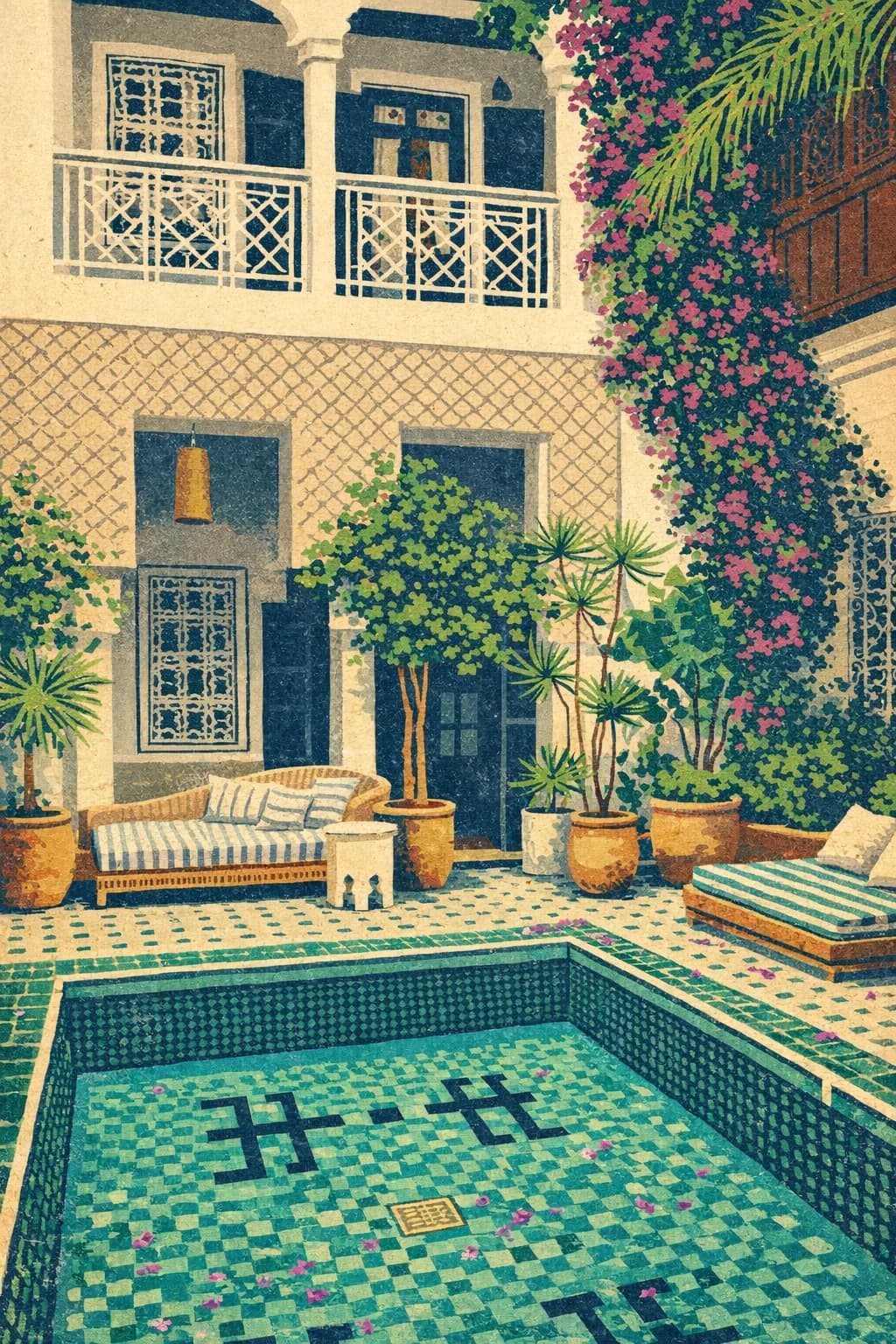
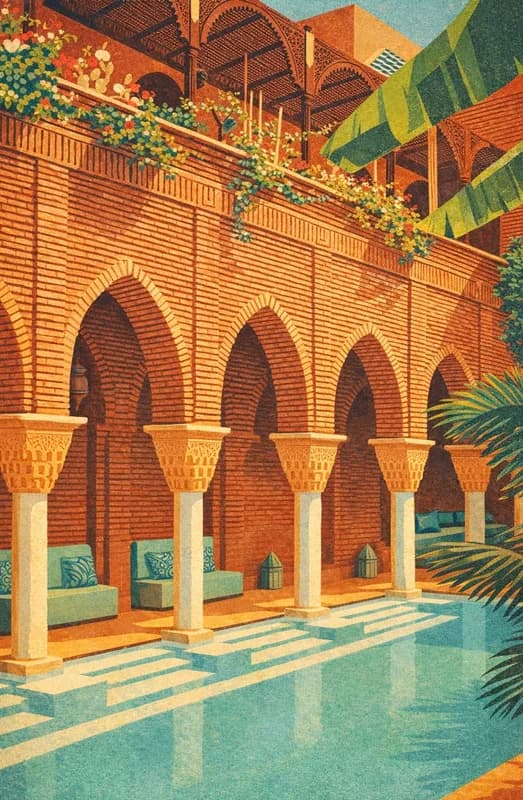
This 17th-century riad in the El Moukef district of the Medina opened as a boutique hotel in 2007, designed by Italian Dario Locatelli. Six suites, each named and styled for maximum drama: the Red Suite has a fireplace and a bathroom built for four.
The Suite of Mirrors puts a ceiling-high mirror wall behind a four-poster bed. The Brown and Black Patio Suites face the internal courtyard through engraved wooden doorways. Tadelakt walls, hand-painted wooden ceilings, and furnishings collected from the owners' travels. La Table Dar Darma serves traditional Moroccan dishes (harira, pastilla, lemon chicken, tagines) with produce sourced daily from the souks. Maîtresse Maria runs cooking classes weekday mornings. Pet friendly.
changed.
Book December four to six months out. October–November is the value window. Skip summer unless heat-tolerant.
In Marrakech, demand runs inverse to the thermometer. When Europe wants winter sun and the heat breaks, the city's riads compress into windows that close months ahead — and that pattern is entirely predictable.
December is the single Peak month, and it behaves like nothing else on the calendar. New Year's Eve collides with European winter-sun demand to squeeze the top properties into a roughly two-week window that books out far in advance. Plan on four to six months of lead time for Ultra-tier riads; three months is often already too late for properties like Riad BE or Le Riad Yasmine.
October and November deliver the best value relative to experience quality. Demand indexes high — 80 in October, 85 in November — but autumn rates at many properties run 30 to 60 percent below spring equivalents because the season falls outside European school holidays. October brings the 1-54 Festival, Marrakech's contemporary art biennale, adding a cultural layer spring lacks. November is the month our data flags as flat-out underpriced: it indexes at 85 without December's premium or the school-holiday crush.
March and April are the traditional high season, driven by Easter breaks and the spring weather window. Easter week is the tightest booking window outside December, and Jardin Majorelle requires timed-ticket advance purchase throughout this period. Ramadan shifts annually across the calendar; when it overlaps with March or April, restaurants and some services run reduced hours while hotels stay fully open.
Check the Ramadan dates before you book — they reshape the dining and nightlife experience far more than the hotel experience.
Summer is the strategic play for price-sensitive travelers who can handle heat. Demand drops below 30 from June through August, and properties that validate as sold out in October often show wide-open availability through July. The medina's thick walls and internal courtyards were built for this climate, so morning and evening exploration stay comfortable — the tradeoff is that midday outdoor sightseeing is impractical. What disappears entirely is the sold-out pressure that defines the rest of the year.
September is the transition window, and it favors the early mover. Temperatures moderate and demand begins to climb, but rates have not yet caught up to autumn levels.
approach.
briefing.
“A six-room fantasy that leaves minimalism in the dust.”
stands.
demand's going.
The real Instagram following over time, plus where this hotel sits for demand in Marrakech. Pick a range, toggle the lines. Followers are reach and demand, not engagement.
assessment.
File closes at HIGH. Book direct a month out; the six-room scale means peak weeks fill quickly. Skip if you want minimal interiors; the Suite of Mirrors sets the maximalist tone for the house.
The numbers behind the tiers
Dar Darma · SOURCE READINGS · REDACTED- Availability density · sampled
- Monthly search volume · raw
- TikTok hashtag views · raw
- YouTube total views · raw
- TikTok following · latest sweep
- Pinterest saves · latest sweep
More from Marrakech.
Get the hotel's Unbookable Score.
Any post or reel with a hotel in it. Booking.com hotel pages work too. One free check, no account needed.