Dar
Kawa.
12 critic reviews
filed.
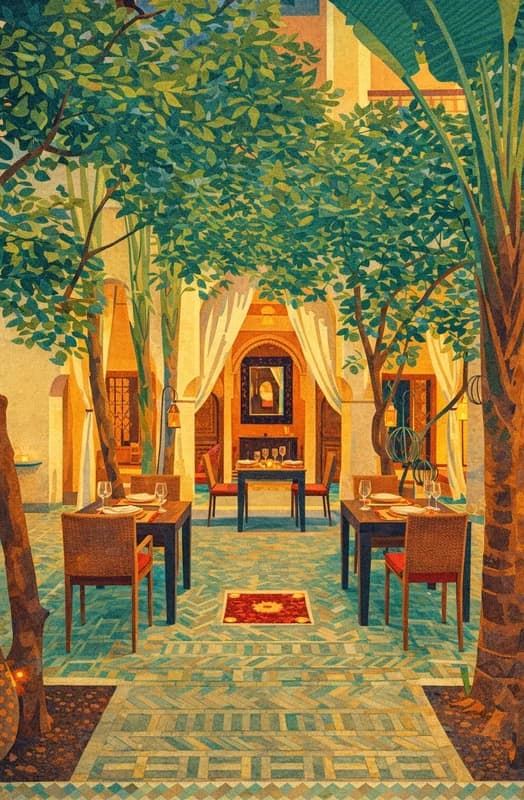
Dar Kawa is the four-room version of the owner-run medina riad done right: the host is a former designer, the objects in the house are her own collection, and the hospitality is genuinely personal rather than hotel-polite. What the hype skips is that four rooms means you are effectively sharing a house with three other couples, so if your idea of a hotel is anonymity this will feel intrusive.
The host will occasionally open her private studio on the top floor to guests who ask the right questions about the art on the walls. It is not a printed tour. Treat the conversation at breakfast as the invitation.
angles.
Barkowski's Textile Eye
Valérie Barkowski designs textiles sold in boutiques worldwide. Her interiors at Dar Kawa are an extension of the textile practice: linen curtains, woven bed covers, colour palettes drawn from natural dyes. Every surface has a texture that a textile designer notices and a hotel designer might not. The rooms feel handmade because the person who made them works with her hands.
Wilbaux's Restoration
Quentin Wilbaux restored the riad's structure in 1999, preserving the traditional Medina bones: courtyard proportions, ceiling heights, wall thicknesses. The architectural restoration and the interior design were done by different people with different specialities. Wilbaux handled the stone. Barkowski handled the linen. The separation of skills shows in a building where the structure and the surfaces are each at their best.
Four Rooms, Twenty-Five Years
Continuous operation since 2000 in a four-room format means the property has been refined over thousands of guest stays without scaling up. The decision to stay at four rooms is a design choice: any larger and the Barkowski intimacy would dilute. Twenty-five years of refinement at four rooms produces a depth that new builds can't replicate.
talk.
mapped.
“Valerie Borkowski's four-room, stylishly minimalist riad painted in tasteful shades of black, white, and steel blue, is tucked deep inside the warrens of the souk.”
record.
Twenty-five years of operation in the Marrakech Medina. Exceptional breakfast included. Organic food focus with local spa products and reduced plastic.
At $$$ pricing for four rooms with a globally recognised designer's interiors, the value is exceptional. Over 20,000 Instagram followers. Demand pressure runs high on four rooms that have been refined over a quarter-century. Twenty minutes from RAK airport. Barkowski's textile eye shapes every surface: linen, colour, texture, light.
changed.
Book December four to six months out. October–November is the value window. Skip summer unless heat-tolerant.
In Marrakech, demand runs inverse to the thermometer. When Europe wants winter sun and the heat breaks, the city's riads compress into windows that close months ahead — and that pattern is entirely predictable.
December is the single Peak month, and it behaves like nothing else on the calendar. New Year's Eve collides with European winter-sun demand to squeeze the top properties into a roughly two-week window that books out far in advance. Plan on four to six months of lead time for Ultra-tier riads; three months is often already too late for properties like Riad BE or Le Riad Yasmine.
October and November deliver the best value relative to experience quality. Demand indexes high — 80 in October, 85 in November — but autumn rates at many properties run 30 to 60 percent below spring equivalents because the season falls outside European school holidays. October brings the 1-54 Festival, Marrakech's contemporary art biennale, adding a cultural layer spring lacks. November is the month our data flags as flat-out underpriced: it indexes at 85 without December's premium or the school-holiday crush.
March and April are the traditional high season, driven by Easter breaks and the spring weather window. Easter week is the tightest booking window outside December, and Jardin Majorelle requires timed-ticket advance purchase throughout this period. Ramadan shifts annually across the calendar; when it overlaps with March or April, restaurants and some services run reduced hours while hotels stay fully open.
Check the Ramadan dates before you book — they reshape the dining and nightlife experience far more than the hotel experience.
Summer is the strategic play for price-sensitive travelers who can handle heat. Demand drops below 30 from June through August, and properties that validate as sold out in October often show wide-open availability through July. The medina's thick walls and internal courtyards were built for this climate, so morning and evening exploration stay comfortable — the tradeoff is that midday outdoor sightseeing is impractical. What disappears entirely is the sold-out pressure that defines the rest of the year.
September is the transition window, and it favors the early mover. Temperatures moderate and demand begins to climb, but rates have not yet caught up to autumn levels.
approach.
briefing.
“Owned by Belgian textile designer Valérie Barkowski, this elegant 17th-century town house, located deep in the medina, is a peaceful showcase for her craft.”
stands.
demand's going.
The real Instagram following over time, plus where this hotel sits for demand in Marrakech. Pick a range, toggle the lines. Followers are reach and demand, not engagement.
assessment.
File closes at ULTRA. Book direct three to four months out; four rooms make this genuinely scarce. Skip if mid-range pricing matters; the twenty-five-year reputation prices accordingly.
The numbers behind the tiers
Dar Kawa · SOURCE READINGS · REDACTED- Availability density · sampled
- Monthly search volume · raw
- TikTok hashtag views · raw
- YouTube total views · raw
- TikTok following · latest sweep
- Pinterest saves · latest sweep
More from Marrakech.


Get the hotel's Unbookable Score.
Any post or reel with a hotel in it. Booking.com hotel pages work too. One free check, no account needed.