Caravan by
Habitas.
4 critic reviews
filed.
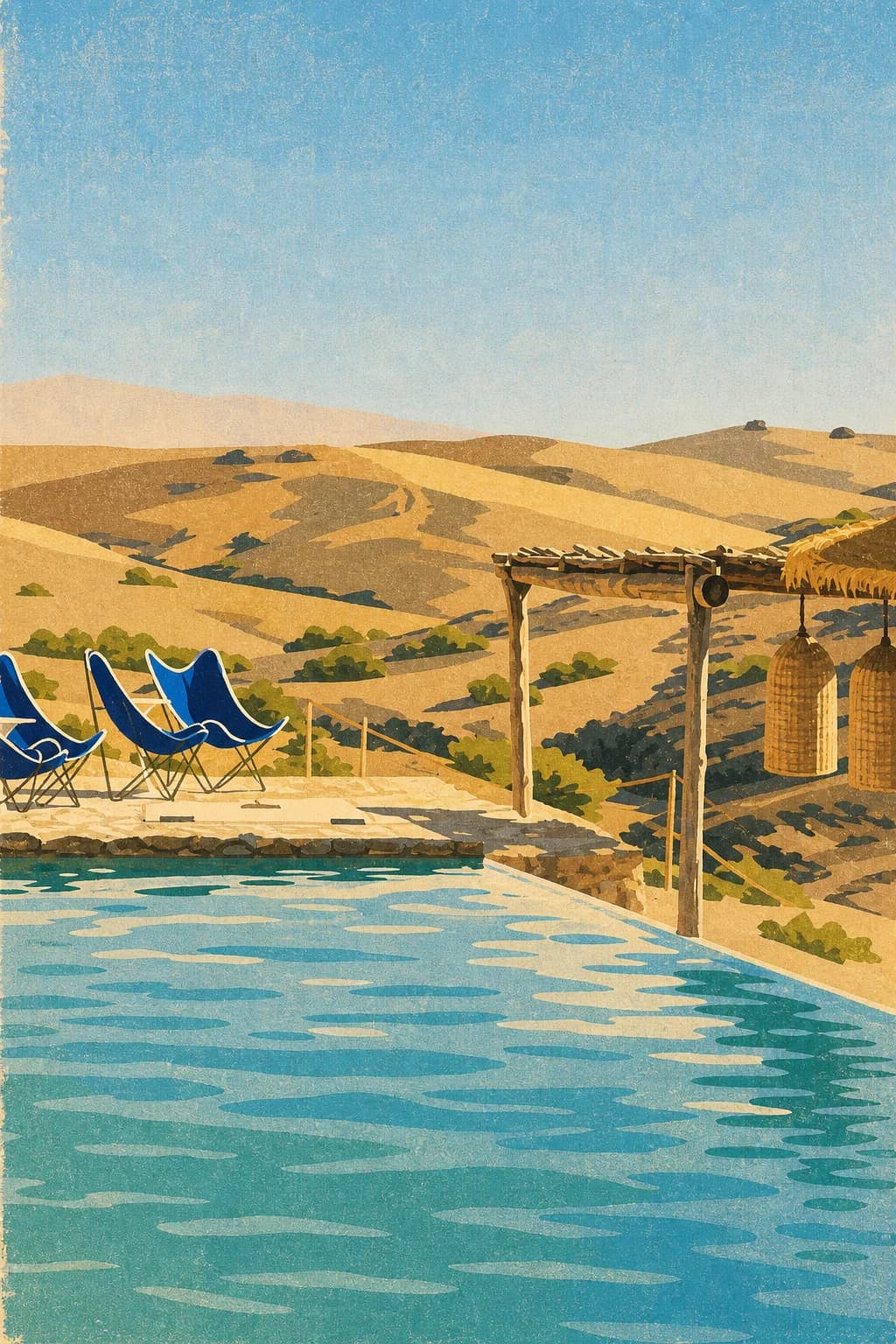
Caravan by Habitas sits in the Agafay desert and the stone-and-stars aesthetic delivers the Agafay experience at a specific style level that the older desert camps do not match. The 20 tents and the communal programme run well. The hype softens that Agafay is a stony desert, not the dune fantasy some guests expect, and the distance from the city means you are committed for the duration of the stay.
Caravan runs a sunrise yoga session on a platform that overlooks the valley, and it is included in the stay but not heavily advertised. Most guests sleep through it. Go on your second morning with coffee and you get the best light of the trip before the heat starts.
angles.
Souk-Sourced Berber Design
The Habitas in-house design team furnished every tent with objects sourced from Marrakech's souks: Berber rugs, leather pouffes, Moroccan lanterns. The architecture draws from Berber dwelling patterns. The result won an AHEAD Award for hotel design. At twenty lodges, the property feels like an encampment rather than a resort. The souk sourcing means no two tents are identical.
The Agafay Desert
Agafay is not the Sahara. It's a rocky desert landscape forty-five minutes from Marrakech, with views of the Atlas Mountains. The terrain is dramatic without the multi-day drive to the Saharan dunes. Sunsets hit the mountains directly. The silence at night is genuine. Habitas chose this location because the desert atmosphere is accessible from the city without the expedition logistics.
RISE and the Community
The RISE initiative contributes $10 per guest per night directly to local communities around the Agafay area. The property uses modular construction to minimise permanent footprint, solar lighting for all common areas, and sources food and materials locally. The community contribution is automatic, not optional. It's built into the room rate and transparent to guests.
talk.
mapped.
“Caravan Agafay is the latest hotel by the Habitas group, who have carved a niche with their sustainable-yet-luxurious eco retreats for travelers who eschew the usual bells-and-whistles amenities.”
record.
Caravan by Habitas sits in the Agafay Desert, forty-five minutes south of the city, facing the Atlas Mountains. Part of the Habitas group's nomadic hospitality model, the 2022 property has twenty tented lodges in two categories: Explorer Tents (solar-powered, stone patios, mountain views) and Atlas Lodges (larger, en-suite, private decks with sliding glass doors).
The design, inspired by Berber dwellings and furnished with pieces sourced from Marrakech's souks, won an AHEAD Award. On-site dining serves Moroccan and international cuisine with vegetarian and vegan options. Pool, spa, yoga pavilion, and live music evenings. The RISE initiative contributes $10 per guest night to local communities. Modular construction and solar lighting. This is desert, not city. The silence at night is the point.
changed.
Book December four to six months out. October–November is the value window. Skip summer unless heat-tolerant.
In Marrakech, demand runs inverse to the thermometer. When Europe wants winter sun and the heat breaks, the city's riads compress into windows that close months ahead — and that pattern is entirely predictable.
December is the single Peak month, and it behaves like nothing else on the calendar. New Year's Eve collides with European winter-sun demand to squeeze the top properties into a roughly two-week window that books out far in advance. Plan on four to six months of lead time for Ultra-tier riads; three months is often already too late for properties like Riad BE or Le Riad Yasmine.
October and November deliver the best value relative to experience quality. Demand indexes high — 80 in October, 85 in November — but autumn rates at many properties run 30 to 60 percent below spring equivalents because the season falls outside European school holidays. October brings the 1-54 Festival, Marrakech's contemporary art biennale, adding a cultural layer spring lacks. November is the month our data flags as flat-out underpriced: it indexes at 85 without December's premium or the school-holiday crush.
March and April are the traditional high season, driven by Easter breaks and the spring weather window. Easter week is the tightest booking window outside December, and Jardin Majorelle requires timed-ticket advance purchase throughout this period. Ramadan shifts annually across the calendar; when it overlaps with March or April, restaurants and some services run reduced hours while hotels stay fully open.
Check the Ramadan dates before you book — they reshape the dining and nightlife experience far more than the hotel experience.
Summer is the strategic play for price-sensitive travelers who can handle heat. Demand drops below 30 from June through August, and properties that validate as sold out in October often show wide-open availability through July. The medina's thick walls and internal courtyards were built for this climate, so morning and evening exploration stay comfortable — the tradeoff is that midday outdoor sightseeing is impractical. What disappears entirely is the sold-out pressure that defines the rest of the year.
September is the transition window, and it favors the early mover. Temperatures moderate and demand begins to climb, but rates have not yet caught up to autumn levels.
approach.
briefing.
“The Agafay Desert is less than an hour from Marrakech, but far enough out to feel like another world. Here you'll find Caravan by Habitas Agafay, a collection of 20 upscale tented lodges.”
stands.
demand's going.
The real Instagram following over time, plus where this hotel sits for demand in Marrakech. Pick a range, toggle the lines. Followers are reach and demand, not engagement.
assessment.
File closes at MODERATE. Book direct a month out, or aim for November to February for cooler desert nights and softer rates. Skip if you want hotel polish; this is a desert camp with intentional rusticity.
The numbers behind the tiers
Caravan by Habitas · SOURCE READINGS · REDACTED- Availability density · sampled
- Monthly search volume · raw
- TikTok hashtag views · raw
- YouTube total views · raw
- TikTok following · latest sweep
- Pinterest saves · latest sweep
More from Marrakech.
Get the hotel's Unbookable Score.
Any post or reel with a hotel in it. Booking.com hotel pages work too. One free check, no account needed.