Why hoi an ranks.
Hoi An sits on the Thu Bon River delta in Quang Nam Province, a few kilometers inland from the central Vietnamese coast. For three centuries it was one of Southeast Asia's busiest trading ports, where Japanese, Chinese, Dutch, and Portuguese merchants unloaded silk and ceramics and left behind a townscape that never got redeveloped. When the river silted up and trade shifted north to Da Nang, Hoi An simply stopped. That accident of stagnation is why the Ancient Town survives today as a near-complete eighteenth-century port, its ochre-walled shophouses, tiled assembly halls, and the Japanese Covered Bridge earning UNESCO World Heritage status in 1999.
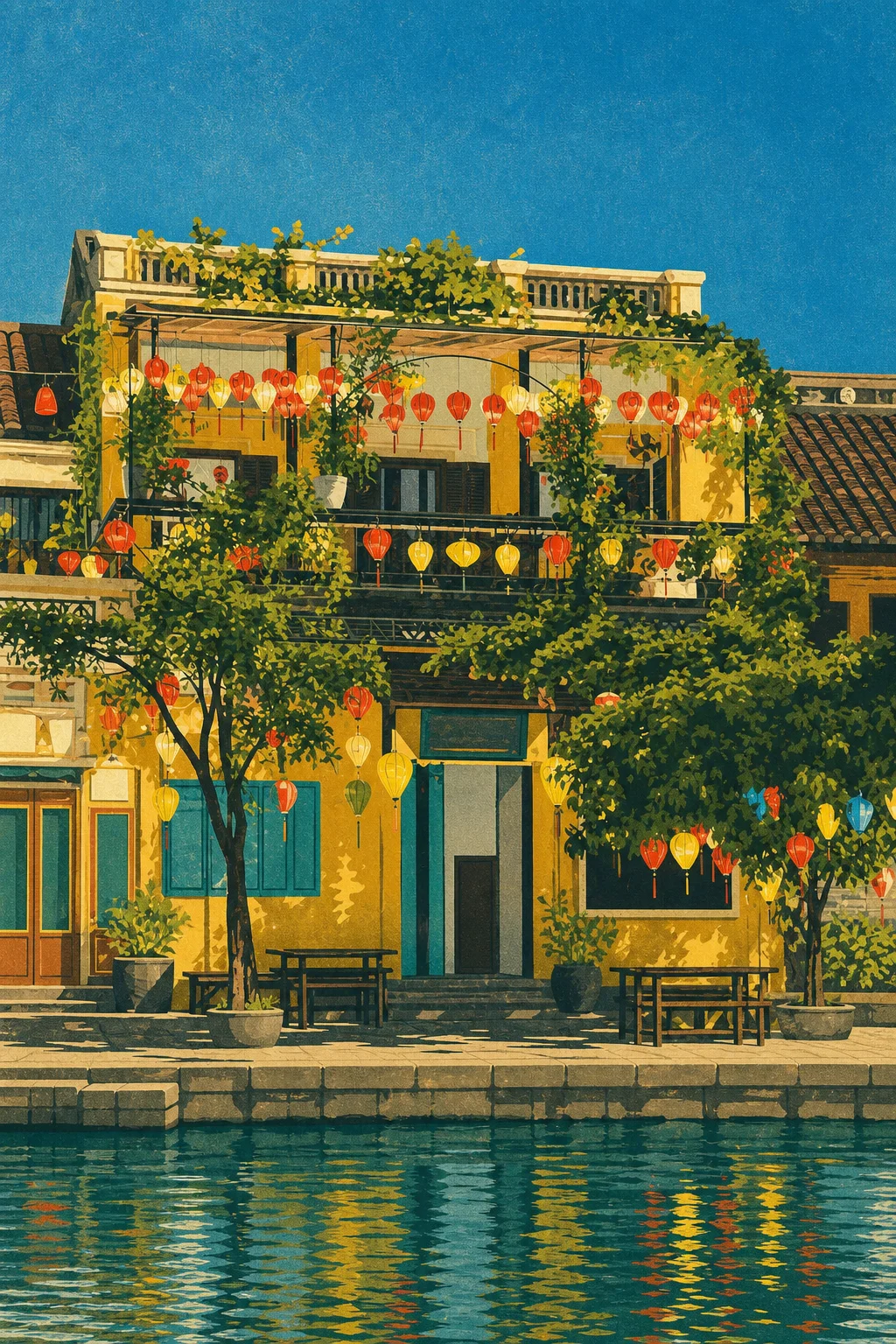
Walk it at dusk and the reason people plan whole trips around this town becomes obvious. Silk lanterns come on above the lanes, the river fills with candle-lit paper boats, and the whole place glows the color of a ripe persimmon. On the fourteenth night of each lunar month the town cuts its electric lights entirely for the lantern festival. But Hoi An is not a museum. It runs on food and cloth: bowls of cao lau, the smoky pork-and-noodle dish that can only be made here because it depends on well water from Ba Le, plates of white rose dumplings, and the banh mi that Anthony Bourdain called the best sandwich in the world. Hundreds of tailors will cut a suit or a dress to measure overnight.
Beyond the heritage core the geography opens out fast. East toward the sea, Cam Thanh's water-coconut palms and basket-boat channels give way to rice paddies; the beaches at An Bang and Cua Dai run north up the coast toward Da Nang. Inland lie the brick Cham temple towers of My Son. This compact spread, an old town, a river, working farmland, and a beach all within a fifteen-minute cyclo ride, is the whole appeal, and it shapes where the hotels sit.
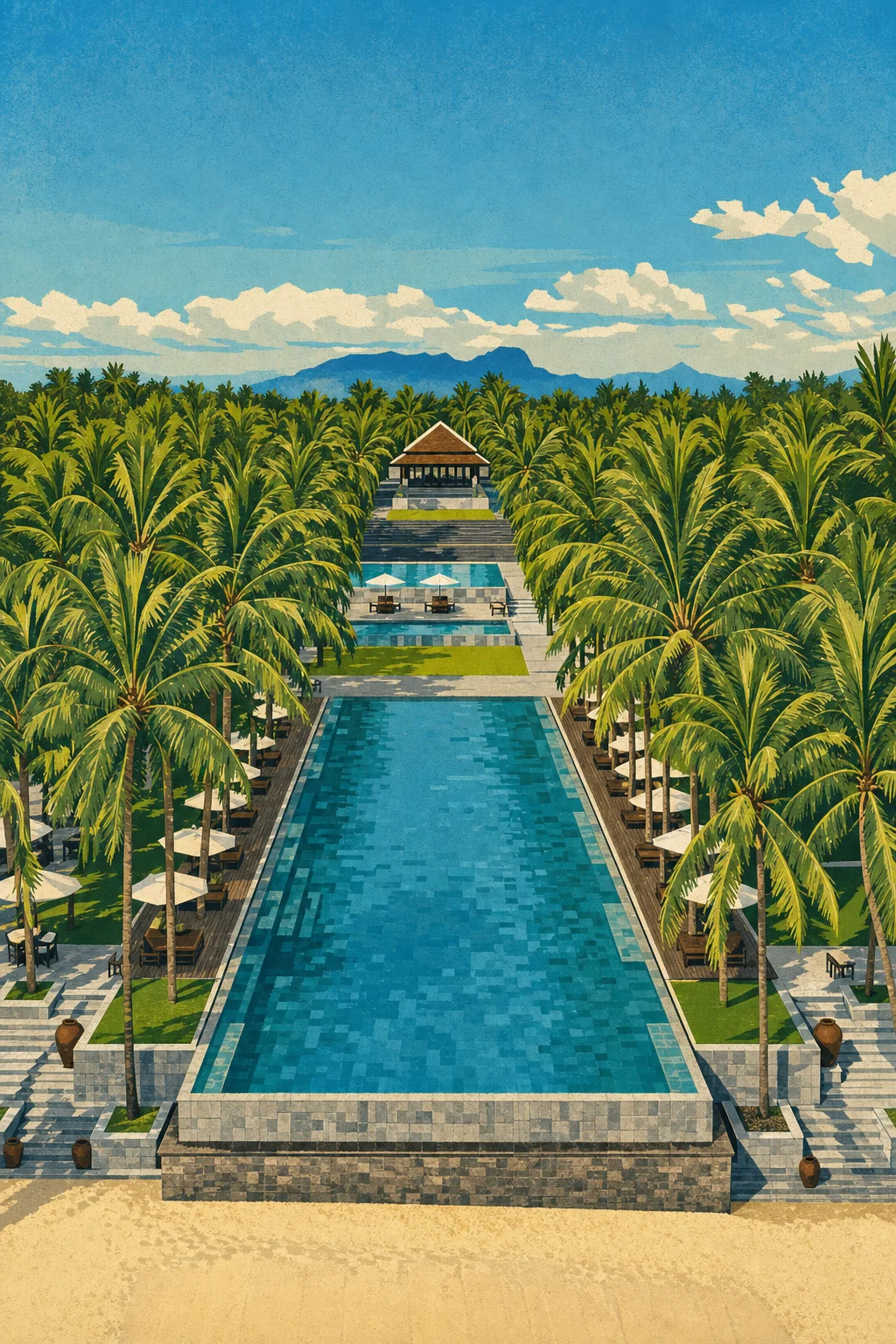
The market splits cleanly along that geography. Inside and beside the Ancient Town, restored merchant-house hotels and full-service resorts trade on walkability and heritage frontage. La Siesta Hoi An Resort & Spa, a 107-room property in the Very High tier, is the archetype: polished service, a spa, and a short walk to the lanterns. Anantara Hoi An Resort works the same riverside address at scale with 94 rooms in the High tier, a colonial-styled resort that has anchored the town's upper end for years. Out in Cam Thanh, the mood shifts to low-slung riverside retreats among the coconut palms. Namia River Retreat, 60 rooms in the High tier, leans into that setting with pools and paddy views, while the single-key Oryza Villa sits in the Very High tier precisely because it is one villa, one booking, one story at a time.
That last point explains most of the booking tension here. Hoi An's Room Demand Scores cluster toward the top not because the town is short of beds, but because the properties travelers actually want are small, distinctive, and set in a place with a hard physical ceiling: the Ancient Town cannot add square footage, and the riverside plots in Cam Thanh are finite. A single-villa retreat like Oryza cannot scale to meet demand without becoming something else. Even the larger resorts feel the squeeze in the February-to-April dry window, when clear skies and the lantern calendar pull three months' worth of demand onto a fixed set of desirable addresses.
The other structural quirk is how bookings happen. Almost the entire tracked roster here reaches guests through the usual online channels; direct-only booking is rare, with just one property in the tracked set holding out for direct reservations. That makes Hoi An easier to reach than a direct-heavy destination, but it does not make the good rooms easier to get in peak season, because availability, not access, is the constraint. The properties worth planning around, from a one-key villa in the coconut groves to a heritage resort a lane from the Covered Bridge, sell their best dates first and hold them tight.
The districts, mapped.
Hoi An's areas sort themselves by how far you are from the Ancient Town, and each trade-off is real. The heritage core, our Ancient Town cluster of sixteen tracked properties, puts you inside the lantern-lit lanes: you wake to the town and walk to dinner, but you also share the streets with day-trippers and tour groups until late. Its tracked average sits in the Moderate band, a reflection of how much variety the district holds, from restored shophouse boutiques to full resorts like La Siesta.
Push east along the river and the character softens. Cam Thanh, nine tracked properties among the water-coconut palms and paddies, carries the strongest average of the inland areas; this is where riverside retreats like Namia River Retreat and one-villa Oryza trade town access for quiet, pools, and space. Follow the coast and you reach the beaches: An Bang, four properties with a boho café culture the expat crowd built, and the resort strip at Cua Dai and Ha My, which posts the highest tracked average of any Hoi An area on the strength of larger beachfront resorts.
The rule of thumb: Ancient Town for immersion, Cam Thanh for calm within cycling distance, the beaches for sand and sunset. The sub-region pages go deep on each.
What's moving.
The clearest signal in Hoi An is the pull eastward, out of the crowded Ancient Town and toward the river and the coast, where returning visitors head once the lanterns lose their novelty. The two areas with the strongest tracked averages both sit outside the heritage core: the beach strip at Cua Dai and Ha My, and the coconut-grove corridor of Cam Thanh. The Ancient Town cluster, despite holding the largest share of tracked properties, averages lower, in the Moderate band. That gap tracks a real shift in what travelers want after a first visit: they come for the lanterns, then return for a paddy-view pool or a beach.
Cam Thanh is the area to watch. It holds a one-villa retreat in the Very High tier, Oryza, alongside larger riverside lodges like Namia River Retreat in the High tier. The coconut-grove corridor has drawn a wave of small, wellness-minded retreats over the past few years, and demand is following them; single-key and low-key stays here punch above their room counts because scarcity is built into the format.
At the top, the Very High tier is thin, just two properties, split between a one-villa retreat and La Siesta's 107-room Ancient Town resort. That thinness is the story: there is no Ultra tier here at all, and genuine peak-tier demand concentrates on a very small number of addresses rather than spreading across the roster.
Beach recovery is the quieter trend. Cua Dai spent years fighting shoreline erosion, and its rebound, along with the less-troubled sands at Ha My, explains why the coastal cluster now posts the strongest area average despite being small.
One thing that is not changing: how you book. Direct-only reservations remain a rounding error here, one property out of the tracked thirty-three, so Hoi An stays reachable through standard channels even as the best dry-season rooms tighten. The friction is timing and scarcity, not access.
The practical year.
Hoi An's demand curve has one sharp spike and a long, flat tail, and understanding why saves both money and disappointment. The February-to-April peak exists because it is the only stretch when central Vietnam reliably delivers dry, mild days. Everything else in the calendar trades certainty for value.
**February through April is the only genuinely reliable weather window, and the entire market knows it.** The winter rains have gone and the brutal summer heat has not yet arrived. That stretch also overlaps Tet, the lunar new year, which stacks a wall of domestic demand on top of the international crowd. If you want a specific room in a small Cam Thanh retreat or a heritage resort near the Covered Bridge during these months, plan on booking three to six months out. The top-tier addresses are few, and they sell their peak dates first.
**May and September are the genuinely undervalued months.** They sit in the shoulder band on price and availability but still deliver plenty of usable weather, and September in particular lands before the rains turn serious. The deep summer of June through August is hot and humid, which is exactly why it prices as shoulder. For beach-first travelers and families who will spend the afternoons in a pool or at An Bang, that heat is a feature, not a deterrent, and it is the easiest time to walk into a good room on short notice.
**October and November are the honest gamble.** This is central Vietnam's wet season, and the Thu Bon can rise enough to flood the Ancient Town's lower streets; locals paddle boats down them most years. Demand stays in the shoulder band, which means the rooms are there and the rates are soft.
> You are trading certainty for value, but nothing closes, so the calculus is yours.
**The lantern festival cuts across every month and ignores the seasons entirely.** It falls on the fourteenth night of each lunar cycle, when the town douses its electric lights for candlelit lanterns. It is worth building a trip around, and it is not a summer-versus-winter decision. Check the lunar calendar, then pick your dates.
Who books here.
Choose Hoi An if you want beauty, food, and texture packed into a small, walkable place rather than a single headline attraction. It is the rare destination where a first-time visitor and a jaded one both leave happy: the Ancient Town delivers instant atmosphere, and the surrounding river, farmland, and beaches give you somewhere to go once the lanterns lose their novelty. It suits slow travelers, food obsessives, couples, and families who want a base that mixes culture with downtime. Tailoring fans and anyone who likes a place they can cover on a bicycle will feel at home.
It pairs naturally with Da Nang and the Cham ruins at My Son, so it works best as the anchor of a wider central-Vietnam trip rather than a standalone long-haul destination.
Skip it if your idea of a holiday is a big empty beach and nothing else; Hoi An's coast is pleasant but it is not the Maldives or the south of Bali, and Cua Dai still bears the scars of its erosion years. Skip it, too, if you cannot handle crowds, because the Ancient Town is genuinely busy from mid-morning until late, and the lantern-lit evenings you came for are shared with a lot of other cameras. And if you are chasing top-tier resort scale and a deep bench of five-star names, other destinations we track offer more of that; Hoi An's strength is character and scarcity at the boutique end, not a wide field of trophy hotels.